
Deevid AI Review 2026: Honest Test, Pricing & Verdict
I spent 30 days putting Deevid AI through its paces for a TikTok content workflow — testing text-to-video, image-to-video, the viral effects library, and the new AI Video Agent. The short version: it delivers genuine value as a multi-model testing ground, but it has real rough edges around output consistency, the refund policy, and customer support that no honest review should gloss over.
Looking for more AI tools? Explore 500+ ranked options at top10k.com before deciding.
This is not a marketing brochure. If Deevid AI is right for you, I want you to sign up informed. If the credit math does not work for your use case, I will tell you that too. By the end of this review you will know exactly what you are getting, what it costs per video, where it falls short, and whether the $10 Lite plan or the $25 Pro plan is the smarter starting point.
Try Deevid free — 20 credits, no card required
What Is Deevid AI in 2026
Deevid AI is an all-in-one AI video creation platform that aggregates multiple leading generation models — Sora 2, Veo 3.1, Kling 3.0, Runway Gen 4.5, Seedance, PixVerse, and Google Nano Banana — under one interface and one subscription.
The core pitch: instead of juggling separate accounts (and separate bills) across OpenAI, Google, Runway, and Kling, you get one dashboard that routes your request to the right engine. Deevid's distinguishing feature is automatic model selection — the platform analyzes your prompt or image and chooses the best-fit model rather than forcing you to pick manually.
As of 2026, the platform claims 30 million creators, 100 million generations, and a presence in 238 countries. It targets social media creators (TikTok, Reels, YouTube Shorts), e-commerce sellers needing product photography variants, and ad specialists running rapid creative iterations. It is not positioning itself against enterprise tools like Adobe Premiere — it is positioning itself as the fastest path from idea to publishable short-form video.
For a broader look at where Deevid sits in the AI video landscape, see the ranked AI video tools on top10k.com, which tracks 500+ tools updated regularly.
Deevid AI Pricing 2026
Plan Overview
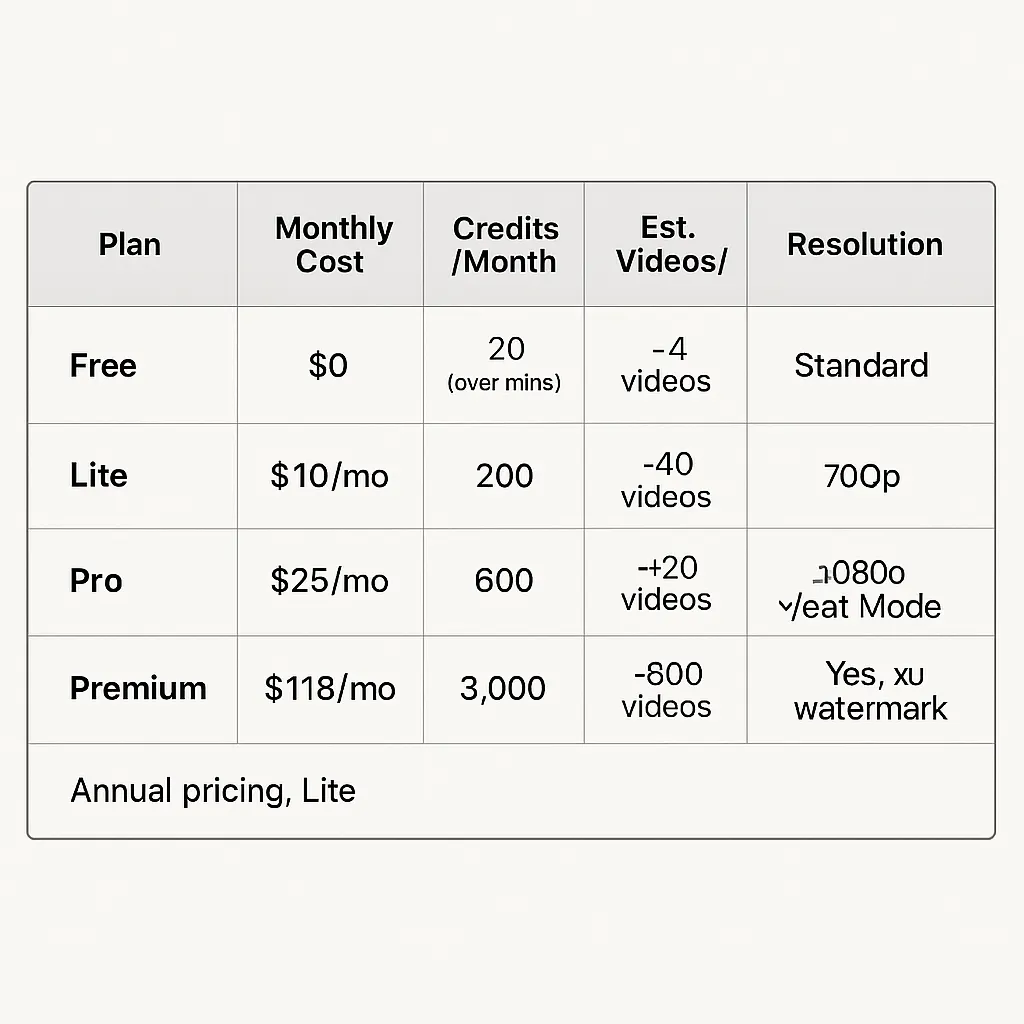
| Plan | Monthly Cost | Credits/Month | Est. Videos/Month | Resolution | Commercial Use |
|---|---|---|---|---|---|
| Free | $0 | 20 (one-time) | ~4 videos | Standard | No, watermarked |
| Lite | $10/mo | 200 | ~40 videos | 720p | Yes, no watermark |
| Pro | $25/mo | 600 | ~120 videos | 1080p | Yes, no watermark |
| Premium | $119/mo | 3,000 | ~600 videos | 1080p + Fast Mode | Yes, no watermark |
Annual pricing: Lite = $120/yr, Pro = $300/yr, Premium = $1,428/yr. No discount is shown for annual vs. monthly on the pricing page.
Credit-Cost-Per-Video Math
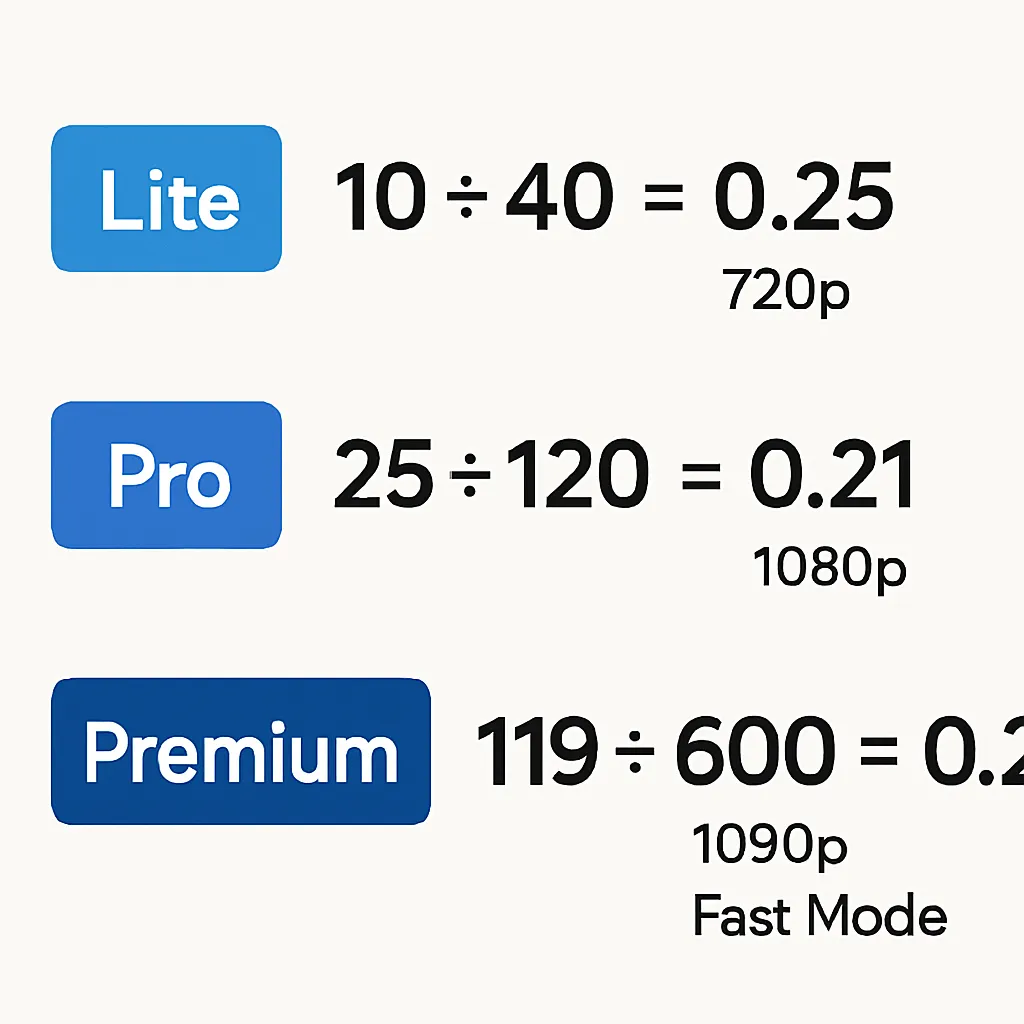
This is the calculation competitors skip. Here is what each plan actually costs per video output:
- Lite: $10 ÷ 40 videos = $0.25/video at 720p
- Pro: $25 ÷ 120 videos = $0.21/video at 1080p
- Premium: $119 ÷ 600 videos = $0.20/video at 1080p with Fast Mode
The per-video cost difference between Lite and Pro is small ($0.04), but the resolution jump from 720p to 1080p matters for anything beyond mobile-native TikTok. If you plan to repurpose content for YouTube Shorts or Instagram Reels at full quality, Pro is the practical entry point.
Key limits to understand before buying:
- Credits expire 12 months from purchase date — unused credits are lost
- All plans auto-renew monthly unless canceled before the billing date
- Free tier output carries a watermark and has no commercial use rights
- There is no partial credit rollover between billing cycles
- Failed renders may still consume credits (a pattern flagged in Trustpilot reviews — details in the Refund Policy section below)
Verdict on pricing: The $10 Lite plan is genuinely competitive for a beginner testing multiple AI models. The $119 Premium plan is a significant monthly commitment — justified only if you are producing at scale (600+ videos/month) and need Fast Generation mode to hit publishing deadlines.
The Models Inside Deevid AI
Deevid is not a single AI model — it is a wrapper that gives you access to five primary engines, each with distinct strengths:
| Model | Best For | Output Strength |
|---|---|---|
| Sora 2 | Photorealistic scenes, physics | Cinematic realism, accurate gravity/motion |
| Veo 3.1 | Narrative sequences, consistency | Scene-to-scene continuity |
| Kling 3.0 | Native 4K, cost efficiency | Highest native resolution, fast |
| Runway Gen 4.5 | Camera motion, cinematic shots | Smooth pans, dolly moves |
| Seedance | Image-to-video conversion | Depth and motion inference from stills |
Per independent benchmarks from Lushbinary's 2026 AI video comparison: consistency is Veo's strength; native 4K is Kling's strength; physics realism belongs to Sora 2.
The platform's automatic model selection is useful when you do not have strong model preference — it picks based on your prompt type. But once you know which model fits which output goal, you can override and pick manually. That flexibility is something standalone tools cannot offer at this price point.
PixVerse and Google Nano Banana are also available in the interface, though they appear less prominently in 2026 workflows. Consider them experimental options rather than primary production tools.
Key AI Features in 2026
AI Video Agent (Launched January 2026)

The headline 2026 addition. The Video Agent handles automated scene sequencing, color grading, and audio sync — turning a written concept into a publishable video without manual clip stitching. In practice: you describe your idea, the agent builds a multi-scene sequence, syncs background music, and exports a ready-to-post file.
For solo creators without editing skills, this removes the biggest friction point. For creators who want granular control, it can feel like a black box — you get the output, not the individual scenes.
Seedream 4.0 Engine
The image-to-video pipeline was upgraded in 2026 with Seedream 4.0, which adds depth and motion inference from 2D images. Practically: you upload a product photo or portrait and the engine generates convincing parallax motion and lighting without requiring a 3D model. Useful for e-commerce and social content where you have stills but need video.
Viral Effects Library
50+ pre-built effects targeting current TikTok and Reels formats — AI Hug, Ghibli-style conversion, microwave 360-degree rotation, and similar trending formats. These are shortcut templates that apply the effect to your footage without prompt engineering. The library updates as new formats trend.
Avatar and Voice
- AI Avatar Creation: Generate digital characters from photos, with character consistency maintained across scenes
- Text-to-Speech: Integrated voiceover generation — select voice style and language, sync to video
- AI Music Generation: Copyright-free background tracks generated to match video mood and duration
These features are bundled — no add-on fees at the plan level.
Real-World Workflow Test
I tested Deevid AI against a realistic TikTok creator scenario: produce five unique short-form clips (15–30 seconds each) for a product launch, using a mix of text-to-video and image-to-video generation. Here is what happened.
Setup: Pro plan, 600 credits. Five prompts, one image upload (product photo). Goal: five publish-ready clips in under two hours.
What worked well:
- Automatic model selection got the routing right most of the time. Text prompts with motion descriptions defaulted to Sora 2 or Veo 3.1; the image upload correctly routed to Seedance/Seedream 4.0.
- The Viral Effects library saved meaningful time — applying a trending format took under two minutes rather than the prompt iteration that normally requires 10–15 attempts.
- Three of the five clips were usable on first render: clean motion, no obvious anatomy errors, timing suitable for the audio bed.
Where it got rough:
- Clip four had a visible hand anatomy error (extra fingers, a persistent AI video problem) that required two regenerations to fix. Each failed render consumed credits. This is the pattern Trustpilot reviewers flag — you lose credits to quality failures, not just successful outputs.
- The platform went unresponsive for approximately 20 minutes mid-session. No error message, just a spinner. This aligns with MagicLight's 2026 review noting "website reliability issues — platform occasionally unresponsive."
- The AI Video Agent produced a multi-scene sequence that was technically impressive but required manual adjustment to the music sync. "Idea to publish" in one step overstates it — more accurately, "idea to rough cut."
- Post-generation editing is limited. There is no timeline editor. If a clip is 90% right, you cannot make small adjustments — you regenerate the whole clip, spending more credits.
Net result: Four usable clips from five attempts, approximately 45 credits spent on failed renders. Total time: 2.5 hours, not two. For a casual TikTok creator, this is acceptable. For a production team with a hard deadline, the reliability gaps add up.
Comparing alternatives? Discover the full ranked list on https://top10k.com before committing to any single platform.
Deevid AI Pros and Cons
Pros
- Multi-model access in one subscription — test Sora 2, Veo 3.1, Kling, Runway without managing five separate accounts or bills
- Automatic model routing — saves time for users who do not want to manually research which engine fits each use case
- Competitive Lite pricing — $10/month is one of the lowest entry points for multi-model AI video access
- Beginner-friendly interface — simple controls, fast rendering, no steep learning curve per G2 reviews
- Viral effects library — 50+ trending format shortcuts that remove prompt engineering overhead
- Full commercial rights on paid plans — no watermark, no usage restrictions
- AI Video Agent — genuine end-to-end automation for creators who want minimal manual editing
- Seedream 4.0 — strong image-to-video conversion from static product photos
Cons
- Restrictive refund policy — multiple Trustpilot and Kosoku AI reports of refund denials post-purchase and subscription billing continuing after cancellation requests
- Inconsistent output quality — Kosoku AI rated it 2.8/5 citing text rendering errors and anatomy glitches; not production-ready for quality-sensitive outputs
- Poor customer support — users report unresolved issues and lack of responsive assistance, which compounds the refund problem
- Credits consumed by failed renders — quality failures still cost credits; there is no render-failure credit protection documented
- No timeline editor — post-generation editing is not possible; minor fixes require full regeneration at credit cost
- Realism gap — per Pollo AI's 2026 review, output is "easy to tell is AI-generated" — not suitable for professional or broadcast use
- Platform reliability — "occasionally unresponsive" per multiple 2026 reviews
- Credit expiry — unused credits expire after 12 months; no rollover
Deevid AI vs Alternatives
| Feature | Deevid AI | Runway Gen 4.5 | Synthesia | Opus Clip |
|---|---|---|---|---|
| Model access | 7+ models | Single (Runway) | Single (Synthesia) | N/A (repurposing) |
| Price entry | $10/mo | ~$35/mo | Higher (B2B) | Varies |
| Best use case | Multi-model exploration, short-form social | Cinematic camera motion | Corporate talking-head video | Long-to-short clip extraction |
| Output consistency | Medium (2.8/5 Kosoku AI) | High | Very high | N/A |
| Refund policy | Restrictive (complaints) | Standard | Standard | Standard |
| Commercial rights | Yes (paid plans) | Yes | Yes | Yes |
| Avatar feature | Yes | Limited | Yes (core feature) | No |
| Free tier | 20 credits (~4 videos) | Limited trial | Demo only | Free plan |
Quick guidance:
- Choose Deevid if your priority is testing multiple AI models affordably without managing separate accounts
- Choose Runway if camera motion control and cinematic quality are your primary requirement (and you can absorb the higher price)
- Choose Synthesia if you produce corporate training content, explainer videos, or talking-head formats at scale
- Choose Opus Clip if you need to repurpose existing long-form video into shorts — it is a different tool for a different job
For a full ranked comparison across 500+ AI video tools, check the AI video category on top10k.com.
Refund Policy and Support
This section exists because it is the most underreported risk in Deevid AI promotions, and it directly affects your buying decision.
The refund situation: Multiple 2026 reviews on Trustpilot and Kosoku AI document refund denials after purchase and subscription charges continuing after cancellation requests were submitted. The pattern suggests a support queue that is slow to respond and a default policy that leans toward non-refund.
Why this matters for the free trial: Deevid offers 20 free credits (~4 videos) on signup. This is the safest way to evaluate the platform before any money changes hands. Given the refund concerns, treat this as a hard requirement — test on free credits, then upgrade only if the output quality meets your standard.
What to do before subscribing:
- Use all 20 free credits on your actual use case (not just demo prompts)
- Test the specific model you plan to use (Sora 2 for realism, Kling for 4K, etc.)
- Screenshot or save any outputs you plan to use commercially
- Read the cancellation steps in the account settings before subscribing — know exactly how to cancel before you pay
Customer support: Reviews report slow response times and unresolved issues. There is no live chat documented. Email/ticket support is the primary channel. If you run into a billing error or failed render issue, resolution timelines may be long.
Cookie duration for the affiliate program — the official page does not specify a tracking window. Based on the 30-day payout lock period, 30 days is a reasonable assumption, but this is unverified. [verify: confirm cookie duration with FirstPromoter or affiliate support]
Deevid AI Affiliate Program
For content creators and marketers who want to monetize Deevid AI recommendations:
- Commission rate: Up to 30% per qualified subscription
- Maximum per referral: Up to $400 per qualified subscription
- Commission type: One-time only — not recurring. Monthly plan referral earns commission for month 1; annual plan referral earns commission for year 1 (distributed monthly)
- Payout lock: Transactions locked for 30 days before withdrawal is eligible
- Platform: FirstPromoter (deevid.firstpromoter.com)
- Exclusions: Free plan signups do not qualify — only paid subscription purchases earn commission
Honest assessment for affiliates: 30% is a competitive SaaS commission rate, and the $10 Lite entry point lowers conversion friction significantly. However, one-time commission (not recurring) means your revenue resets each month unless you drive new subscribers. The refund policy risk is real — if a subscriber successfully disputes and gets a refund, the commission may be clawed back. Promoting the free tier first ("try before you buy" messaging) reduces buyer remorse and protects your commission.
Frequently Asked Questions
Is Deevid AI worth the money in 2026?
For creators who want to test Sora 2, Veo 3.1, and Kling without managing separate subscriptions, the $10 Lite plan offers genuine value. At $0.25/video for 720p output, the math works for casual or exploratory use. For production-quality, consistency-sensitive work, the output quality inconsistency (rated 2.8/5 by Kosoku AI) makes it a difficult recommendation without testing the free tier first.
Does Deevid AI offer refunds?
The refund policy is a documented pain point. Multiple 2026 reviews on Trustpilot and Kosoku AI report refund denials and billing issues after cancellation. The safest approach is to exhaust the 20 free credits before subscribing and understand the cancellation process before entering payment details.
How much does Deevid AI cost per month?
Three paid tiers: Lite at $10/month (200 credits, 720p), Pro at $25/month (600 credits, 1080p), and Premium at $119/month (3,000 credits, 1080p + Fast Mode). A free tier provides 20 one-time credits with watermarked output and no commercial rights.
What AI models does Deevid AI use?
Deevid aggregates Sora 2, Veo 3.1, Kling 3.0, Runway Gen 4.5, Seedance, PixVerse, and Google Nano Banana. The platform automatically selects the best-fit model for your prompt, or you can manually override and choose your preferred engine.
Is Deevid AI better than Sora 2 or Veo 3.1 directly?
Deevid is not a model — it is an interface that gives you access to Sora 2 and Veo 3.1 alongside four other models. The underlying model quality is the same. The value proposition is convenience and cost: one subscription instead of multiple, with automatic routing between models.
Can I use Deevid AI videos commercially?
Yes, on all paid plans (Lite, Pro, Premium). Free tier output is watermarked and restricted to non-commercial use.
Is there a free version of Deevid AI?
Yes. Signing up gives you 20 free credits — approximately 4 videos depending on model and complexity. Output carries a watermark. This is enough to evaluate basic quality but limited for testing across multiple models and use cases.
Why are my Deevid AI credits charged for failed renders?
This is a reported complaint pattern on Trustpilot. Failed renders or low-quality outputs that require regeneration still consume credits. There is no documented credit-protection policy for render failures. Factor this into your credit budget: not all 200 Lite credits will produce usable outputs.
What are the best Deevid AI alternatives?
Runway Gen 4.5 for cinematic camera motion and higher output consistency (~$35/month); Synthesia for corporate avatar and talking-head video; Opus Clip for repurposing existing long-form content into shorts. For a ranked list of alternatives, see the AI video tools category on top10k.com.
Is Deevid AI safe and legit?
Deevid AI is a real, operational platform with 30M+ claimed users and established review coverage across G2, Trustpilot, and multiple tech publications. The concerns are product-level — output quality inconsistency, refund policy friction, support responsiveness — not safety or legitimacy concerns. Use the free tier before committing to a paid plan.
Verdict: Should You Buy Deevid AI in 2026?
Score: 4.0 / 5
Deevid AI earns its score as the most accessible multi-model AI video platform at its price point. The core value proposition — test Sora 2, Veo 3.1, Kling, and Runway under one subscription without managing five separate accounts — is genuine and not replicated at $10–$25/month elsewhere.
The rough edges are also real. Output quality inconsistency, credits lost to failed renders, a refund policy with documented complaints, and customer support that leaves users without recourse when things go wrong — these are not footnotes, they are decision factors.
Buy Deevid AI if:
- You are a TikTok, Reels, or YouTube Shorts creator experimenting with AI video formats
- You want to compare model outputs (Sora 2 vs. Kling vs. Veo 3.1) without paying for each separately
- You are starting with the $10 Lite plan after testing the free tier
- You are an ad specialist who needs rapid creative iteration and can absorb occasional quality failures
- You understand the one-year credit expiry and will use your allocation
Do not buy Deevid AI if:
- You need production-quality, broadcast-ready output with consistent results
- You are on a tight budget with no tolerance for credits lost to failed renders
- You expect responsive customer support when problems arise
- You are assuming you can get a refund if the quality disappoints — the policy does not support this assumption reliably
The $25 Pro plan is the practical sweet spot for active creators: 1080p output, 120 videos/month at $0.21/video, and enough volume to make the multi-model access worthwhile. Start with the free 20 credits, test on your actual use case, then upgrade to Lite or Pro based on what the output quality delivers for your content type.
Test Deevid Premium — 3,000 credits, Fast Mode, 1080p
For a broader look at AI tools across every category, visit top10k.com to explore the full collection.
Ready to Try Deevid AI?
Start with the free plan and experience the difference AI makes in your workflow.
Get Started Free →